
“If you treat me like a whore, you’re going to pay me like one.”
I hated Mara from the very start of this book. I decided immediately that this wouldn’t be my favourite in the series. I thought Temple — a character we’d already come to know from the previous books — deserved better. I held a real grudge against the heroine. What she did is… unforgivable. Apparently I’m worse than Temple in that regard, but I live with it just fine. Or William, his real name, heir to a dukedom, robbed of everything at eighteen. His future. His dignity. All because of her.
It’s in Mara Lowe’s bed that the young future duke is found, sheets soaked in blood (at the time, there was no way to discover that the blood actually belonged to a pig), and it’s from that moment on that doubt spreads. Is he his father’s fiancée’s murderer? The name “the Killer Duke” sticks to him from then on like a second skin, and it’s under that name, that aura, that he lives from then on. For twelve years. Because even he doesn’t know whether he’s innocent of that crime, the memory of that stolen, altered night comes back to him only in senseless flashes: a woman, a scent, a laugh.
Duke of Lamont, but really, turned into a fighting machine ever since he left home and sought shelter in the streets. Some fight for power, others for pleasure. Temple fights for peace, the inner peace that keeps slipping through his fingers, that he never finds even though every night he climbs into the ring and, invariably, wins. He fights for the moment when he’s no longer “just muscle and bone, movement and force, sleight and feint.”
Violence is the only pure thing left in his life. He becomes an unbeatable, unstoppable fighter, his victims the men who, having lost everything at The Fallen Angel — the casino he co-owns alongside Bourne, Cross and Chase — get one last chance to win it all back if they can beat him. No one ever does. Not once.
Mara appears out of nowhere one night, after her brother loses everything, not to set the record straight after twelve years, not out of remorse for what her plan did to Temple, but because, finding herself without money, she’s willing to sell the truth. She offers him absolution for a crime he didn’t commit, in exchange for forgiving her brother’s debt.
How is it possible to like a heroine like that? “I never wanted you to be hurt.” Rings hollow. “The world believes what it wants to believe.” The flimsiest excuse for a man’s ruined life. And when Temple asks her directly whether she has any remorse over what she did, her answer makes clear there’s no room for remorse in her. And we hear her inner thoughts, telling herself she did what she had to do to survive. She let Temple be seen, for years, as her own murderer. Fine, I’ll admit it — she didn’t win me over, and my resentment toward this heroine only grew.
Cherry on top: she asks, at that first meeting, “Are you angry?” Fuck, I thought. Of course he’s angry. You orchestrated a conspiracy, destroyed a man’s life, and you think he feels how, exactly? But the negotiation continues, and Mara promises to tell him the truth about what happened between them that night, with one condition: save her brother.
At this point, when Temple is still nowhere near foolishly in love, he says to her: “Do you think that’s a fair trade for destroying my life?” She commits to restoring the truth on his terms. Retribution. He tells her he wants her time too, to carry out his plan — that it won’t be as simple as just saying “I’m alive.” Temple wants revenge. To end her reputation. To humiliate her. And here comes the first line of hers that actually pulls me toward her: she tells him that if he’s going to treat her like a whore, he’ll pay her like one. Deal closed.
But right after that, something else irritated me: that she runs an orphanage. I thought it was a rather convenient device to make Mara likeable, to make her forgivable after ruining a man’s life for twelve years. Aren’t they meant to be the romantic pair of this book, after all? I get that a miserable life awaited her had she married Temple’s father but if she had that much resourcefulness to devise a plan like that to escape it, couldn’t she have used it in a way that didn’t put another human being’s life at risk?
Then, infuriatingly, I started to sympathise with her — as Temple’s plan starts falling into place. As the humiliation he’s preparing to inflict on her comes into view.
The scene with the dressmaker paves the way for that. I start to wonder whether, even given what Mara did, it justifies the terrible humiliation Temple puts her through. Is the Duke’s goal to restore the truth, or to take revenge by humiliating her, again and again?
On the other hand, when Mara sees the scars on Temple’s body for the first time (yes, he was attacked trying to defend her), she starts to grasp the real pain she caused that man. Along that journey of discovery, we come to understand that Mara pushed the consequences of what she did at sixteen into some remote corner of her conscience, as a way to survive and move forward and that it’s only through constant contact with him that this awareness starts to surface, to the point where she accepts humiliation after humiliation from him as her due.
This is where I started to question things myself. What she did to that man was horrible but does it justify revenge built on that monstrous dose of humiliation as legitimate currency between them? Temple loses some of his shine here. The scene in the boxing ring, where he brings her to climax and then turns his back on her, leaving her exposed: total humiliation. And even then, she understands that she loves him, and accepts the humiliation as a punishment. But there’s a limit, even for Mara. When Temple tells her, “If your orphanage fails, you’d make an excellent whore” — that’s the humiliation she won’t accept. And after giving him a well-deserved slap for it, right before the fight ahead, she tells him: “I hope he wins.” “He” being Temple’s opponent in the match about to take place.
But she works her way under Temple’s skin too. That woman fighting to hold on to her dignity makes him wonder: “What if I were with her?” and “What if she were mine?” (always that possessive streak in every one of Sarah’s heroes). Through their charged, erotic education of one another, Temple realises she doesn’t want to hurt him. He starts asking himself what game they’re really playing. Her strength fascinates him. She’s his equal.
And her question eats away at him: “After it’s all over, where does that leave me?”
Until, with everything already staged for the truth to come out, he realises that what he’s really after isn’t reclaiming his place in society — it’s that woman.
In the end, Temple regrets his revenge and cancels his plan. He falls in love. But she’s fallen in love too, and now regrets everything she did. And so, she reveals the truth to the world.
What’s remarkable about this author — and credit where it’s due — is how she manages to build the characters’ motivation and inner transformation and make it believable, no small feat given how difficult the story’s starting premise was: Temple falling in love with the very woman who destroyed his life.
To be fair, she does take her time getting them to a place where staying together feels earned (the elastic gets stretched pretty thin at this point in the story, but fine). He searches for her relentlessly and, with the help of a character from The Fallen Angel (who gets his own book — the fourth in the series), manages to convince Mara that what he wants isn’t his old life back, but a new one, with her.
Because in all those years of being Temple, he became the man he is today. Because, in the end, he comes to realise he gained more than he lost by being diverted from the role that was meant to be his. Because, in the end, he found Mara — his equal.
No Good Duke Goes Unpunished — Score
Category: Chemistry between the protagonists
Score: ⭐⭐⭐⭐☆ (4/5)
The attraction between Temple and Mara builds slowly, through negotiation and a shared erotic education of one another, out of one of the hardest premises in the series — falling for the person who destroyed your life. Compelling, but the heavy dose of humiliation woven into it makes the chemistry harder to fully root for than in other books.
Category: Characters
Score: ⭐⭐⭐⭐☆ (4/5)
Temple is a magnificent character: the fighter seeking a peace that keeps slipping through his fingers. Mara is far more divisive: her justifications (“I did what I had to do to survive”) don’t fully land, and the orphanage feels like a convenient device to make her forgivable. Still, her slow reckoning with the real damage she caused is well built.
Category: Dialogue
Score: ⭐⭐⭐⭐☆ (4/5)
Sharp, loaded exchanges throughout the negotiation (“If you treat me like a whore, you’re going to pay me like one”; “I hope he wins”). The dialogue does real work carrying the shifting power balance between them, even when the characters themselves are hard to like.
Category: Intimate scenes
Score: ⭐⭐⭐☆☆ (3/5)
Charged with tension, but overshadowed by how much humiliation gets folded into the physical intimacy — the ring scene in particular.
Category: Prose/style
Score: ⭐⭐⭐⭐⭐ (5/5)
Vivid, controlled writing — the recurring “muscle and bone, movement and force” motif, the fight-ring imagery, the slow surfacing of Mara’s buried guilt. The author’s ability to make an unlikely redemption arc feel believable is genuinely impressive craft.
Category: Originality
Score: ⭐⭐⭐⭐☆ (4/5)
A genuinely difficult premise — the hero falling for the woman who ruined his life — tackled head-on rather than softened. Where it loses a point is in leaning so heavily on humiliation as the emotional currency between them, which feels less fresh than, say, Cross’s restraint in Book 2.
Category: Overall score
Score: ⭐⭐⭐⭐☆ (4/5)
Not a favourite going in — the heroine is genuinely hard to forgive, and stays that way for much of the book. But the craft behind the transformation, and the final understanding that Temple gained more than he lost, make this a strong book.
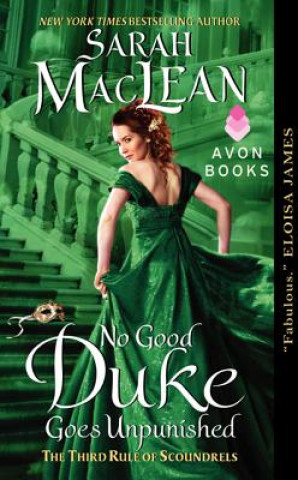
Title: No Good Duke Goes Unpunished
Series: The Rules of Scoundrels (Book 3) — also subtitled “The Third Rule of Scoundrels”
Author: Sarah MacLean
Original publication date: November 26, 2013
Publisher: Avon Books
ISBN-13: 978-0-06-206854-5
ISBN-10: 0062068547
Pages: 400 (mass market paperback edition — some editions list 384)
Genre: Historical Romance (Regency/Victorian)
Original language: English
Awards: RITA Award for Best Historical Romance; Romantic Times award for Historical Romance of the Year


Leave a Reply