
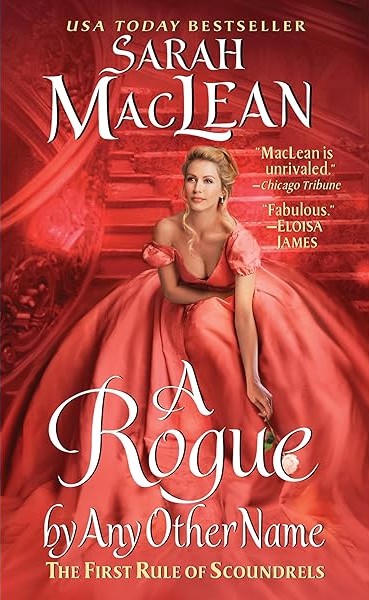
“He might be planning to marry her, but he was not planning to care for her.”
This was the first book by this author I ever read. I came to Sarah MacLean after Julia Quinn, Eloisa James and Elizabeth Boyle. I already found the intensity of some of Boyle’s books and passages amusing, but here, I was hooked from the very first line. The way a book opens matters so much. If it grabs you and, at the same time, leaves you a little lost, searching for the map — perfect.
“The Eight of Diamonds ruined him.” That’s how the first book in this four-part saga begins. In a dark, decadent place, our hero, the Marquess of Bourne, gambles away everything he has, everything that until then defined him as a member of the British aristocracy. He plays, and in losing, he destroys his own predetermined future and begins the hero’s journey. All in a single hand. Twenty-one years old, playing twenty-one, against an opponent who, we discover, had manipulated the young marquess’s addiction to steal every last thing he owned. But is the future we grow up believing in the only one we can ever hope for?
The book jumps forward nine years, and we find that Bourne has risen from the ashes, saved first by his friend Temple (whose true identity is only revealed in the saga’s third book), and then by the mysterious Chase, who makes him one of the four owners of The Fallen Angel, a casino where aristocrats gamble as if there were no tomorrow and Lucifer watches closely from the shadows.
And so we get to know Michael Bourne, the male lead of this book, and he had me from the start (if you don’t like the main characters, it’s impossible to get into a book — at least for me, with my shameless weakness for dark, hardened, unfeeling men). We come to understand that Bourne is hard and, above all, burning with vengeance against the man who took everything from him in a card game. Everything we associate with a genuine bad boy is here, and for many pages of the book, the “transformation” we sense will come by way of love takes its time arriving. It’s easier to like them and root for them because these bad boys are invariably, terribly attractive. Strong. Muscled. Virile. With a fierce instinct to protect women. With hands that know how to touch, to explore, and tongues that do delicious things to a woman’s body. Experts in the art of pleasing a woman in bed. Speaking, in moments of greatest tension, in that rough voice that rises from the depths of desire and the dizzying loss of self-control. And, no less important, capable of falling completely, overwhelmingly, scandalously and possessively in love.
I love bad boys. And in this book, Bourne’s awakening toward his more human side is a slow transformation, but one that gets its first spark when he meets the female lead, Penelope, nine years on. A friend from a childhood he lost, a symbol of the innocence stolen from him, she is the means to reclaim his lands, his dignity, and his revenge. And he genuinely treats her badly in the early chapters. Forced to marry her, since the lands are part of her dowry, he ignores the happiness with which she greets him — the memories of a childhood friend still fresh in her mind — and ends up kidnapping her, carrying her over his shoulder like a caveman, giving her a slap on the backside, and hacking a table to pieces with an axe for firewood, to warm the empty old house where he takes her. Could this get any more primal? Of course the heroine resists, with kicks and slaps that stand no chance against the hero’s muscled body. Even so, in the middle of this scene, the attraction between the two begins to build. There are her blue eyes and soft skin, his dark hair and eyes with their myriad flecks of green and brown, all these details of one another they keep noticing, even in the middle of a kidnapping.
Conclusion: Bourne is a beast in the opening pages, but the heroine, without ever losing her clear-eyed view of exactly what he is, cannot help feeling that pull toward him and neither can I. And a note here: these books aren’t just about being politically correct. Thank God. They’re about fantasy. And, in this case, it’s always the fantasy of muscled, virile, possessive men who look at us as if we were the last Pepsi in the desert, but who first have to fight hard against the feelings we stir in them. No one in their right mind wants this to turn into a squeaky-clean story.
And speaking of plain — here we have Penelope, the female lead. Presented as the perfect lady. Made to be accomplished, discreet, never rocking the boat. Accepting the fate handed to her at birth: marry well. But this is where the Sarah MacLean factor kicks in. In her books, every woman has a strength she often doesn’t know she has, one that reveals itself when she’s pushed into extraordinary circumstances. And this Penelope gains ground and strength as the book goes on, moving from the “plain” lady who follows the rules to a woman who wants to write her own destiny in a world ruled by men’s rules.
Penelope is the typical product of a sexist society, one where the blame almost always falls on women. Engaged at nineteen to the perfect duke, she finds herself traded for another woman, whom he falls hopelessly in love with (that whole story is told in the book Eleven Scandals To Start To Win a Duke’s Heart). That experience shapes her in two ways: on one hand, it shows her that love stories do exist and that marrying for love is possible; on the other, being left behind makes her wonder if something is wrong with her. Would the ex-fiancé have stayed if she’d been prettier, more seductive, more perfect?
I love this slow awakening of Penelope’s. The moment she realizes she can stop being a victim and become the author of her own fate. When, after nights alone at home, she chooses to go after adventure instead. Penelope is the discreet lady who wakes up and fights for the man she loves, but also fights for herself. And if she can’t have love, she’ll have adventure. If she can’t have that man, then she’ll have The Fallen Angel, that whole new world made of vice, gambling, and pleasure. And I love even more how she becomes a bold player, capable of negotiating with someone as hardened as Michael. Of making sure her sisters get the chance that was stolen from her: to marry for love. And of reaching, despite the attraction, the point where she tells him she doesn’t want him to touch her, reclaiming her body as her own.
But as she reveals more and more of her strong personality, her ability to fight for what matters to her — in this case, her sisters — Bourne’s attraction to her becomes more and more impossible to control. She wins him over through the purity of her heart and the strength of her will, her dignity.
There’s no strict morality in this book. Bourne grows rich off other men’s vices, off the pull of gambling, off human weakness. And Penelope admires him because he rose from the ashes and built everything through his own merit. But too much morality is a bore, right? Enough with redemption arcs where the hero simply gives up revenge for a future with the woman he loves. That gaming hell, the Fallen Angel, is far too rich in subtext to be tossed aside so easily, or for Michael to end the book as a simple landowner.
In the end, she’s the only one holding the map to this hardened rake’s heart. “The Eight of Diamonds ruined him.” It was also the card that saved him when, near the end of the book, she plays it and wins. With the eight of diamonds. But really, the winner is him — the one who realizes that revenge can never matter more than happiness. Isn’t that beautiful?
A Rogue By Any Other Name — Score
Category: Chemistry between the protagonists
Score: ⭐⭐⭐⭐⭐ (5/5)
Bourne’s attraction to Penelope builds against his own will, even as he tries to keep her at arm’s length while pursuing revenge. The tension between his hardened exterior and his growing inability to control that pull makes for a compelling, slow-burn dynamic.
Category: Characters
Score: ⭐⭐⭐⭐⭐ (5/5)
Bourne is the classic dark, vengeful hero, but his transformation feels earned rather than rushed. Penelope’s arc is even stronger: she moves from the “plain,” rule-following lady to a woman who claims her own fate, negotiates with a hardened man, and reclaims ownership of her own body.
Category: Dialogue
Score: ⭐⭐⭐⭐☆ (4/5)
The negotiation scenes between Bourne and Penelope stand out, especially as she grows bolder and starts holding her own against him. Their dialogue is emotionally intense rather than particularly witty or funny, but after all, both characters are naturally quite serious.
Category: Intimate scenes
Score: ⭐⭐⭐☆☆ (3.5/5)
Bourne fits the archetype of the possessive, virile hero whose hands “know how to touch, to explore.” There’s plenty of tension and physical attraction throughout, though this isn’t the author’s spiciest work. The standout moment is the final sex scene between the two, set at The Fallen Angel.
Category: Prose/style
Score: ⭐⭐⭐⭐⭐ (5/5)
The opening line — “The Eight of Diamonds ruined him” — is called out explicitly as hooking the reader from the very first page. The card motif returns meaningfully at the end, tying the whole narrative together with real craft.
Category: Originality
Score: ⭐⭐⭐☆☆ (3.5/5)
Leans fully into familiar bad-boy tropes — the kidnapping, the caveman-carry, the forced marriage — embraced knowingly rather than subverted. Fun and effective within the genre, but less genre-bending than other entries in the series (see Cross, the “elusive hero”).
Category: Overall score
Score: ⭐⭐⭐⭐☆ (4,5/5)
A gripping series opener that hooked the reader from its very first line. The unapologetic embrace of fantasy over “squeaky-clean” morality, paired with Penelope’s satisfying evolution from victim to author of her own fate, makes this a strong start to the saga.
TECHNICAL SHEET
Title: A Rogue by Any Other Name
Series: The Rules of Scoundrels (Book 1) — also subtitled “The First Rule of Scoundrels”
Author: Sarah MacLean
Original publication date: February 28, 2012
Publisher: Avon Books
ISBN-13: 978-0-06-206852-1
ISBN-10: 0062068520
Pages: 400 (mass market paperback edition)
Genre: Historical Romance (Regency)
Original language: English
Awards: RITA Award for Best Historical Romance, 2013


Leave a Reply